
ISKCON Temple is located at Raja Dhirshain Marg, Sant Nagar near the East of Kailash locality. It is one of the 40 temples in India that belongs to the International Society for Krishna Consciousness, dedicated to Lord Krishna.

From a restaurant to a museum, a library and a special animatronics show, ISKCON has it all. While looking around if you get hunger pangs, you need not go further than the completely vegetarian restaurant Govinda. It is open 7days a week and the timings are as follows :
Breakfast- 8:00 AM-9:30 AM; Lunch- 12:00 Noon-2:30 PM; Snacks- 4:30 PM- 6:00 PM; Dinner- 7:00 PM-8:00 PM


Temples in Delhi are renowned both for its religious fervor as well as its historic connection. The simply yet beautifully made, the interior walls of this temple in Delhi have been decorated with aesthetic works of Russian artists representing the different phases of life of various deities like Radha-Krishan, and Sita-Ram.
 The main attractions of the ISKCON Temple are its central prayer hall and the temple museum. The fine-looking and pleasing idols of Radha-Krishna with other deities are present in the central hall with informative religious lines and shibboleths. The temple museum on the other hand organizes multimedia shows to make the devotees understand the story of the epics Ramayana and Mahabharata. It also gives a brief interpretative understanding of views, philosophy and practice of the Hare Krishna cult. This is an interesting feature of the temple and should not be missed.
 During our last visit, we were lucky to be able to attend the morning prayer. The morning prayer starts from (4.30 am, 7.15 am, 7.45 am) and evening prayer time are as follows (12.30 pm, 7.00 pm, 7.45 pm). The main prayer hall closes from 12.00 pm to 4.00 pm. Try to visit the temple on Sunday afternoons, and you will be overwhelmed to be a part of the kirtan, aarti, pravachan and prasadam, that continue till evening.
 If interesting legends of mythology and their scientific relevance fascinates you, then remember to visit the ISKCON museum, ensconced on two floors of the temple building. Pinned to a common goal to present Indian history in an interactive manner, the temple authority has taken initiatives to organise a light and sight show garnished with life-like figures of Hindu mythology, that makes a huge impact on the audience. Portraying the the best of science and religion, the exhibition is a must see for every visitor. Stroll in the ground floor and you can see beautiful motifs that brings the forlorn preachings of Bhagwat Gita, back to life. As you will climb higher, the whole backdrop changes to that of Ramayana and Mahabharata stories.
 In the Animatronics Centre which is in the temple premises, through three different screens, you get to see how the temple was formed, the idea behind it and the spread of the Hare Krishna clan in many other countries. As the show ends, the main animatronics begin. Created by using hi-end technology, the show is controlled by 3 computers networked together and connected to a remote control. One computer controls the overall show, second one acts as the laser discs controller and third one controls the movements of the robots. All 3 computers are synchronized to time codes written on the laser discs, which are the three 3 hi-tech robots of Krishna, Arjuna and Srila Prabhupada, the founder of ISKCON.
 This is one place, which has been successful in combining science and technology with religion. Even the books and other information that have been displayed here are of interest to those who love to wander in the premises.
There are gift and book shops within the temple premises. Every time I visit I always buy the lovely Krishna printed T-shits for gifts which are reasonably priced. They are so very attractive that you cannot stop yourself from buying it. Another specialty is it’s aggarvati’s (incense sticks) which we always buy it for ourselves and our granny’s.
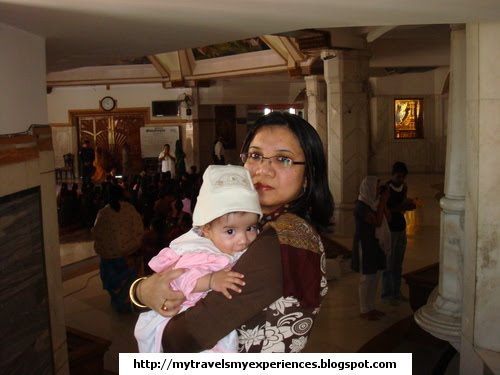
Be very careful about your shoes. Before entering the temple you need to remove your shoes. Keep them in the area managed by the temple authorities "to keep shoe's" and not any place in the temple premises . You are bound to lose them. Jeet lost his new pair of shoes as he was lazy to go the area managed by the temple to hand over his shoes.
Time to Visit: Open on all days
Preferred Timings: Morning Prayer time (4.30 am, 7.15 am, 7.45 am) and evening Prayer time (12.30 pm, 7.00 pm, 7.45 pm).
The main prayer hall closes from 12.00 pm to 4.00 pm.
Admission Fee: Free and open to all.
How to Reach:Tourists can either take local buses from various points within the city to reach the temple or they can hire auto-rickshaws and taxis or take the metro rail.
Nearest Metro Station: Central Secretariat
Nearest Railway Station: Nizamuddin Railway Station
Nearby Places to Eat: The famous Govinda Restaurant in the temple complex offers excellent Satvik meals (without garlic and onions), Hotel Park Royal, Karim's, Supper Factory and Salims in Kailash Colony Market, McDonald's and sophisticated eating joints in Greater Kailash-1's market, many good food joints in Nehru place including the likes of Nathu's, Domino's Pizza, many good restaurants in Kalkaji Market and C. R. Park markets.
For more details, you can visit the official website http://www.iskcondelhi.com/index.asp


