Showing posts with label dhows Q8. Show all posts

Thursday, May 27, 2010

Kuwait National Museum

When you shift base to a new country the best place to know about that country, its history, culture and custom is to visit its museums. That’s the first step we took after landing in Kuwait. We visited the Kuwait National Museum. After that many more visits followed taking parents, in-laws, my brother and friends.

Located in Kuwait City on the Arabian Gulf Street between the Seif Palace and the National Assembly (Parliament), the Kuwait National Museum was planned by Michel Ecochard. A few feet away, there is Al Sadu house which faces the Gulf street. Though the architectural project and the plans of the museum were ready in 1960, actual construction started only in 1981. It was on February 23, 1983 that two of the four buildings were inaugurated; the planetarium was opened on February 16, 1986. One of the four blocks of the museum houses all administrative wings, offices and an auditorium. The permanent exhibits are displayed in the other three blocks.

The museum has an interesting history. It was originally the residence of Sheikh Ahmed Al Jaber Al Sabah. But the archaeological discoveries at Failaka created a need for a place to house these important finds. A department of Antiquity and Museums was also set up by the government and the department bought the former home of the Al Badr family in Kuwait City and turned it into the national museum.

                                                        Boom Al-Muhallab(a very big dhow) is part of the museum


A tour of the Kuwait National Museum of Kuwait makes you discover the wonderful art collection of the Al-Sabah dynasty. The rich trading history of Kuwait is unfolded in the treasure trove displaying archaeological findings of the Failaka Island, various artifacts and the remnants of the ancient pear diving dhows.

The roofs of the building are of concrete with an aluminum frame covering the garden and the buildings.

Upon entering the guard takes your civil ID and gives you a visitors badge. The entry to the museum is free.

There are two types of museums, the first museum is a display of artifacts found on Failika island during an archaeological dig, wooden doors of the past, terracotta and engraved tools, animal fossil which is 16million old, group of blades and cutters from flint stone and Neolithic age, silver statues and bronze coins from the bronze period and Hellenistic period. But when we first visited the museum it had exhibits at two floors. The ground floor was the same but the first floor had musical instruments and various types of radios used in the past. But in our later visits, we found the first floor closed and there were no exhibits.

The next museum is my favorite. It's a museum of Kuwaiti heritage. It looks like Kuwait during the 40's and 50's, like a small village. The displays include statues imitating the old ways of Kuwait. From merchants selling their goods to what a typical Kuwaiti house looked like before the invasion of modern technology. So simple were the olden days. There are old photos dating back to 1942. You will come to know that Kuwait was once a simple trading hub and that a lot of people depended on the sea for earnings. In the next post I will write in detail about the Heritage Museum.

Although the museum was looted, burned and destroyed by Iraqi invaders, efforts to restore most of the artifacts and important materials were made. Even today there's plenty to do and view at the four buildings and the planetarium that make up the National Museum. But one thing I noticed is that it is the most neglected place when you compare with other places of interest. I feel the government should pay more attention to it.

Anyhow, it is a real great place to visit if you're interested in the past.
 
Museum Visiting Hours :

Monday to Saturday: 8.30-12.30AM   4.30- 8.30PM
Friday        Morning off.         Afternoon :  4.30-8.30

Friday, May 21, 2010

Al Hashemi 2...securing d past 4r future generation, Q8

If you plan to visit Kuwait or stay in Kuwait, you should visit the Al Hashemi II. Whenever anyone visits us from India, we never forget to show them this majestic wooden ship. This ship of gigantic proportion, rises high above the Radisson SAS Hotel, Kuwait.
This impressive structure is the realization of one man's vision and dedication to preserve Kuwait's maritime heritagefor the future generations. Apart from bringing back memories of those graceful bygone days of sail, it has been recognized by Guiness World Records as the largest wooden dhow in the world.                    
For Husain Marafie, one of the owners of the hotel,this was his third and most ambitious dhow-building project. Mohammedi 2, his first enterprise, houses the popular Al Boom Restaurant, followed by Al Ghazeer, which is the Radisson SAS Hotel's pleasure cruiser. Al Hashemi 2, the newest dhow dwarfs its older sisters. 
 Husain Marafie has named his present dhow Al Hashemi 2, in celebration and commeration of the memory of his forerunner,which saw active service for the Marafie family. For him, the preservation of Kuwaiti maritime heritage and the continuation of his family's shipbuilding and ship-owing traditions that span well over a couple of centuries are a driving passion. It was in 1985 that Husain Marafi started planning how to achieve his unique ambition of constructing a dhow of gigantic proportion.
 His intensive involvement in the construction of his other two dhows, and the  great amount of scholarship he had undertaken in traditional marine architecture,amply assisted himin this complex enterprise. The tragic Iraqi invansion however caused a setback in the progress of this project. For various reasons,groundwork for the permanent berth of Al Hashemi 2, could not resume until the second half of 1995. On 10th February 1997, the actual construction of Al Hashemi 2, began with the commencement of laying her keel. The construction of the ship cost more than 30 million dollars through 2001.


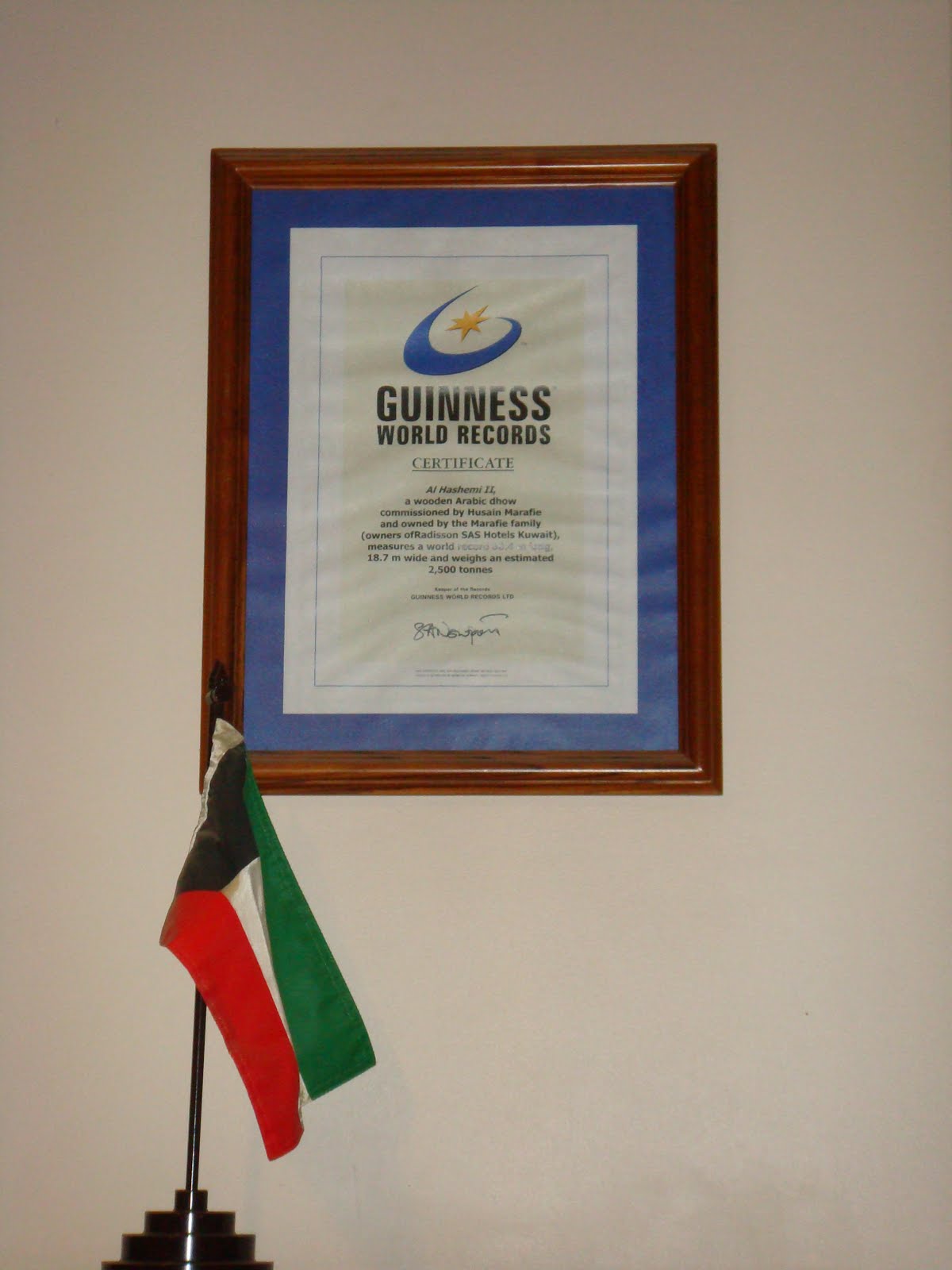
It is use as a restaurant and will never be put to sea. While maintaining all the qualities of an ocean-going dhow of the past century, Al Hashemi 2, is fitted out an exquisite banqueting hall. A replica of a pre-oil era Kuwaiti village fabricated using contemporary materilas and a marine museum to house about 30 scale models of various historical and exciting dhows dedicated to traditional art of shiping has been built beside Al Hashemi 2. A variety of marine articles, pictures of traditional significance and photographs depicting various stages of construction of Al Hashemi 2, form part of the marine museum. This time when we took my brother, we couldnot visit the museum as it closes at 5pm. We were little late. So we wandered over the dhow and took photographs. There is a large parking area under the concrete slab on which the Al-Hashemi-II sits.On the wall of the museum is a certificate, dated 2002, from the Guinness World Records announcing that Al-Hashemi II, the huge and unmissable wooden dhow adjacent to the museum, is the largest wooden boat on earth, measuring a world record-breaking 80.4m long, 18.7m wide and weighing an estimated 2500 tonnes.


The centre piece of the lobby at Radisson  SAS Hotel is an amazing 4772 kilogram granite ball floating on a bed of water. So perfectly balanced that it can be rotated with gentlest of pressure, the "KUGEL" is indeed unique. It was first seen by Husain Marafie, in 1975 in the USA and during the renovation of the hotel, he decided that the Kugel would be ideal for the renovated hotel. Already assembled before shipment from Germany and weighing a total of 8000 kilograms( or 8 tons) it took 9men over 10hours to transport the ball outside the hotel to its present position, two forklifts moving in tandem assisted the operation.

So when you visit the hotel next time, check out the lobby and take a break to marvel at this ingenuity of modern physics.

If you would like to have more information about Al Hashemi2, check out the following webpages


Wednesday, May 12, 2010

Scientific Center,Q8


The next day we decided to go to the Scientific Center because it is an interesting and informative place where you can mingle learning with pleasure. A must-visit place, especially for inquisitive minds both young and old.
From Kuwait travel guide you'll come to know that it is located on the waterfront at Ras Al Ardh in the Salmiya region  and serves as a center for environmental education of the gulf region.


 It was initiated by late Sheikh Jaber Al-Ahmad Al-Jaber Al-Sabah and its compound covers an area of over 80,000 square meters with the building itself covering over 18,000 square meters.

It houses the largest aquarium in the Middle East, and tourists can have a wonderful time focusing on the natural habitats of the sea, getting a glimpse of the underground passages rich in marine life, the desert of the Arabian Peninsula and natural habitats of the coastal edges. Each area contains specimens of animal, plant and marine life found in that region.

The Desert Section of the Aquarium allows visitors to discover specimens of wild life found in the kuwaiti desert and the Arabian Peninsula. Desert animals have the ability to evolve and deal with the extremes of their very harsh environment , yet some of animals here have been hunted almost to extinction and barely managing to survive.
In the Coastal Edge, there are a variety of animals and wildlife .Wetlands and coastal areas are inhabited by species able to withstand extreme environmental conditions, and play the important rule of linking the ecosystems of the desert and sea.
The habitats found around the coast such as estuarine and mangrove areas are critical in providing nursery grounds for marine life and are also one of the major sources of nutrients into the marine realm. The Coastal Edge represents this diverse ecosystem containing; crocodiles, river otters, birds and numerous marine animals, which can be seen by visitors as they explore the peaceful surrounds of a beach and tropical garden.
The Marine section of the Aquarium is a truly sensual experience designed to transport visitors into the deep seas via magnificent sights and sounds. It contains several tanks. Most of the marine animals were collected locally, while others have been obtained from other tropical waters of the world. TSCK Aquarium tanks include over 100 species of marine animals: Sharks, Rays, jelly fish, live corals and a variety of other fish. The Aquarium exhibits are continuously changing as animals grow and reproduce and new additions are made.

This is a surprisingly amusing way to spend a few hours and learn something. Plus it's always nice to gaze at a giant floor to ceiling tank, and realize how vast and varied the world "below" is.

For more detail information on the aquarium check the website:  


Probably the most dramatic of the tanks is the Arabian Gulf Fishes tank, with a capacity of 1.5 million liters of water that houses a variety of sharks and rays. Another awe inspiring tank contains sharks and rays of the coral reefs, with the capacity of 100,000 liters. There are scheduled public feedings in these two tanks for visitors to witness, done by young Kuwaiti divers of the Scientific Center. To know in details about the feeding time of the sharks, check this out http://www.tsck.org.kw/en/feeding_schedule.asp

And if you plan to dive with the sharks during your visit to the Scientific Center then check this out…
 http://www.tsck.org.kw/en/dive_with_sharks.asp


There is also a 250 seat IMAX film theater where you can catch up a movie with your friends. Another major attraction of the Kuwait Scientific Center is the Dhow Harbor spread over an area of 2000 sq. meters. Housing the only surviving Kuwait sailing ship from the pre-oil era, boom Fateh-el-khair, the Dhow Harbor gives the visitor insight into a vital part of the Kuwaiti heritage. Located directly on the water front, the Harbor includes samples of various smaller dhows and vessels used during this period.


All of these are located within this complex. However, each one has a separate entry fee. It has a special section for children, called the Discovery Place, which houses oil and gas exhibitions and a puppet theatre.

The centre is open from Saturday to Wednesday from 09:00 – 12:30 and from 17:00 – 21:30, and on Thursdays from 09:00 – 21:30. On Fridays, the centre opens at 14:00 and closes at 21:30. Prices vary depending on what sections you want to visit. More details can be found on the website.... https://www.tsck.org.kw/eticketing/mainpage.asp.
 And if you need any information, you can call 1848888 or email info@tsck.org.kw

The building enclosure is filled with designs of Arabic calligraphy as well as Islamic art. Along with this, the walls literally have the history of Kuwait written on them. Its architecture is inspired by both the "old" mud-homes of Kuwait and the sail of a ship. The mud-home correlation is seen as the mud-colored ceramic used on the exterior of the building, while the mast is the top "roof" part of the building which is made of fabric similar to that of the sails of dhows, which are an important part of Kuwaiti history of pearl diving. The colors chosen were meant to create the atmosphere of the "desert" both inside and out, with the inside continuing on the theme of Kuwait's heritage and culture, built into the walls of the Scientific Center.


Another major reason why Kuwait Scientific Center has become a hot favorite both among the locals as well as the tourists is the presence of the onsite gift shop and Kuwait's favorite restaurants like Burger King and Pizza Hut. You can laze and relax in the tastefully decorated indoor dining area, or enjoy the breathtaking views across the Gulf from the outdoor dining area while munching on yummy sandwiches and pastries. Or have a walk in the impressive and awesome walkway.


Wednesday, March 3, 2010

Maritime Museum, Q8

Located at the SAS Radisson Hotel, the Al-Hashemi Maritime Museum is housed in the Al Hashemi II, which is the world’s largest wooden Arabic dhow (It’s in the Guinness Book of World Records!).

The museum reflects the countries maritime culture. It showcases traditional shipbuilding and seafaring in Kuwait and features large models of different traditional dhows, sea tools and accessories highlighting Kuwait’s long maritime and trading traditions. The large dhow also has a Grand Ball Room and several other reception areas that are used for weddings, conferences, dinners, etc. The museum is free to visitors.
One our first visit to Radission Hotel we could not visit the museum as it closes at 3pm.

Dhows- integral part of Q8's History

Dhows are integral part of Kuwait’s culture and heritage. The starting age of using the dhows is clouded. Among all the different types of great sailing ships in the world, the dhow holds the longest continuous tradition of commercial seafaring. Dhows were mainly used for trading cargo, pearl diving, fishing and other more uses.
Kuwait's fleet of dhows was one of the most impressive rights until the development of the oil industry of Kuwait. Kuwait's economy depended mainly on three maritime activities: trading voyages, shipbuilding, and pearl diving.
If you want to know about and see a traditional dhow, then places you should visit during your stay in Kuwait are dhow harbor next to Sharq Mall in Kuwait city and the dhow harbor behind the Scientific Complex in Al-Ard area and the Maritime Museum located in the SAS Radisson Hotel.