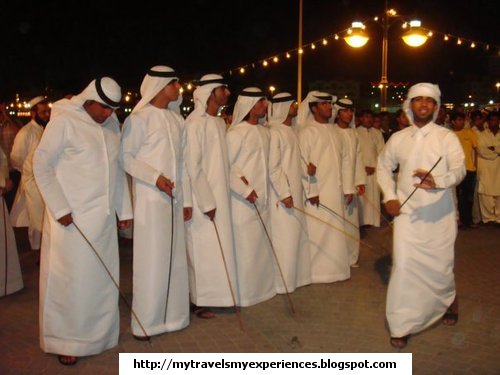
Just a few steps ahead is the Heritage Village, full with activities. A traditional heritage village, located near the mouth of the Creek, has been created where potters and weavers display their crafts. It focuses on the UAE’s maritime past, trading activities and local history. There are several traditional shops, handicraft stores and exhibitions—you can also ride a camel. It’s a great place to see the more traditional aspects of Dubai life that are missing from the modern city. Here the visitor can look back in time and experience some of Dubai’s heritage. There are displays, which include a tented Bedouin village with traditional weapons, chests and household utensils.
It reminded me of Dilli Haat (a combination food plaza and craft bazaar located in the heart of Delhi. It has stalls representing each state of India, giving a complete variety of tastes available all over India.) The Heritage Village has many shops selling souvenirs, but the shop keepers are mainly Indians or Bangladeshi’s. They speak and dress like a Arabic and sometimes it becomes difficult to understand that they do not belong to Dubai. Here you need to do hard bargaining. We purchased a spoon and freeze magnet as souvenir from a shop whose owner was from Kerala, India. There are also many small shops run by Bedouin women, where they make and sell varieties of food items mainly sweets. It was a pleasure to see live demonstration of Arabic food being made. While I took rest on a bench, and was feeding MEHR, Jeet went and purchased few Arabic roti's, filled with omlette and cheese. It was really very tasty. The Arabic food stall was full with customers and you have to wait for a long time for your turn. The village was full with not only tourist but also local Arabic people as it was Eid holiday.
During Eid special programmes are held. So we got the opportunity to see a Bedouin marriage. I was sitting next to an Arabic family. They were very friendly and explained me in details the rituals of the marriage. At first the bride’s family came, singing and playing musical instrument. There were no male/ gents in the group; only ladies. They were making so much noise that we were confused as to what was happening. Then the Arabic lady next to me told me that it is a marriage ceremony that is going to take place and that the bride is coming with her relatives and friends. Her relatives in box’s and trunks carried things that would be given to her for marriage (cloths, accessories, jewellery etc). Even one of them was carrying a pillow. After they took their seat, they showed to public one by one all the items. They sang marriage songs and in the middle of the songs would make some noise from their mouth, which we call “uruli” in Assamese (India). In the same way, the bridegroom came with his relatives and friends. In the village the traditional dance and songs were also performed as part of the wedding. Folk dance and music performances are staged from time to time in the village.
The village boasts a number of cafeterias and a seafood restaurant. The village provides a glimpse of Dubai’s traditional culture and lifestyle. Thus it is an enjoyable, interactive look at Dubai ’s past.
For more you can check the website: http://www.dubaicity.com/What_to_do_in_dubai/dubai_heritage.htm
Near the Village, are two Arabic restaurants. They must be very popular as it was over crowded. The people were smoking sheesha, eating, enjoying the fresh air of the sea and the Creek side view. We could not find a place so decided to walk down to our hotel. On our way to the hotel, we visited Meena Jewellery and checked out few earnings and chains. It was late and it was time for the shop to close. Anyway I did not like the designs and decided to check shops later, the next day. We had dinner at Bhavna Veg Restaurent. It cost us 13 dirham per person; quite cheap. They gave lot of things..Plain rice, pulao, two vegetable sabzi, 2 chutney’s, roti, aachar, lachi,dal, kofta,lemon and papar. But the food was not very tasty (ok type) and the restaurant especially the basin / hand wash area was very dirty.
We hurried back as it was getting late to feed MEHR.
Showing posts with label dubai creek. Show all posts
Thursday, April 8, 2010
Wednesday, April 7, 2010
Diving Village, Dubai
Just few minutes ahead of Sheikh Obaid bin Thani House, is the Diving Village, which is a collection of pearl-diving artefacts and pictures of Dubai’s pearl divers and marine life. Some of the black and white photos are interesting, reflecti ng the tough life that many divers endured before scuba diving was invented. The village forms part of an ambitious plan to turn the entire Shindagha area into a cultural microcosm, recreating life in Dubai as it was in days gone by when pearl diving and fishing were central to Dubai’s economy and Dubai Creek became a central hub for trade in the region. Fish’s mainly sea fish found in the Gulf region is kept in tanks and aquariums. You will also find fishing nets and boats here.
Pearl diving, one of the oldest professions in the region, existed almost six to seven thousand years back. A pearl diving ship carried 10-60 people on board for an expedition. The team comprised a captain (Nokhaza), some divers, seeb, and other staff. The diver often risked his life to gather pearl studded oysters from the sea bed. He used to dive deep for more than two minutes to collect a handful of oysters. The season lasted only for six months starting from April because the Gulf waters during this season were warm and safe.
There is a gift shop ( mainly items made of pearls) found here .
Pearl diving, one of the oldest professions in the region, existed almost six to seven thousand years back. A pearl diving ship carried 10-60 people on board for an expedition. The team comprised a captain (Nokhaza), some divers, seeb, and other staff. The diver often risked his life to gather pearl studded oysters from the sea bed. He used to dive deep for more than two minutes to collect a handful of oysters. The season lasted only for six months starting from April because the Gulf waters during this season were warm and safe.
There is a gift shop ( mainly items made of pearls) found here .
Sheikh Obaid bin Thani House, Dubai
With the soft wind blowing we enjoyed our walk. On our way to the Heritage house from Sheikh Saeed Al Maktoum House, we came across Sheikh Obaid bin Thani House. The entry to this house is free. It’s an old house with a large courtyard and several rooms for the family members and special entrance for the female guests. The Pippal tree (common in India) in the courtyard provided ample shade for the members entertaining their guests or enjoying a gathering. We were pleasantly surprised to see such a big old pippal tree in the courtyard. Now in the rooms are details on how the Universe started and teaching of Quran are beautifully shown in screens.
One of the first houses of Al Shindagha, Obaid bin Thani’s House was built in 1917 of maritime stones and gypsum, thus reflecting the prosperity of the region at that time due to the flourishing pearl trade.The 1250 sq.m two storey house is made of stone and mud with traditional style windows, doors and facades.The Sheikh Obaid Al Thani’s House, just like the Sheikh Saeed Aal Maktoum’s House and the adjoining Heritage Village, is itself a tribute to Dubai Government’s determination to preserve the local heritage and cultural values. The house is an oasis of tranquillity in an otherwise bustling month in Dubai’s calendar.
Sheikh Saeed Al Maktoum House - Now A Heritage House
We had a good view of Dubai through Wonder Bus Tour and also saw lot of sea gulls in the creek. I tried to capture them in my camera as the bus was moving through the Creek but couldnot get the perfect picture.
At around 3.45 we returned to Burjuman Mall from the Wonder Bus tour. We walked down to our hotel as it was nearby. It took us around 20minutes. MEHR was very tired and slept. We took rest in our room for some time and around 6.30pm we were out again. We walked to the Creek side area as we had plans to visit the Sheikh Saeed Al Maktoum House, Heritage Village and Diving Village. We had never been to this side of the Creek. You will feel as if you are in India. As we walked towards Sheikh Saeed Al Maktoum House, we found lot of middle class/ working class bachelors sitting, relaxing and talking to each other. Also lot of Indian shops, mainly textile shops are there in this area. We first visited Sheikh Saeed Al Maktoum House.
Sheikh Saeed’s House overlooking the mouth of the Creek at Shindagha is a listed national monument that showcases the history and development of Dubai. Dating back to 1896, this imposing building was once the seat of local government, the nucleus for political and social organizations of the day and the official residence of Sheikh Saeed Al Maktoum, the father of late Sheikh Rashid Bin Saeed Al Maktoum, the architect of modern Dubai, and the grandfather of the present Ruler, Sheikh Maktoum Bin Rashid Al Maktoum. It is one of the oldest building in Dubai, as well as one of the best examples of traditional architecture. It is situated next to the Heritage and Diving Village.
The ambitious restoration project, begun in 1986, won a coveted award from the Arab Cities Organization for the conservation of heritage buildings. Today, fully restored to its former glory, the building houses an impressive exhibition of photographs, paintings, lithographs, stamps, coins and art objects that vividly portray the early development of the Emirate. The air-conditioned museum is divided into wings as per the different historical and cultural periods. Presently this palatial home boasts of photos that depict the different generations of the Al Maktoum family.
The restoration of this house to a museum did not destroy the traditional architectural designs as the wooden lattice screens, carved teak doors and windows, and the balustrade railings are still preserved. The ventilation screens that are set into the walls are designed with floral and geometric designs. It is built in the traditional manner, from coral covered in lime and plaster, all built with very thick walls to provide maximum coolness. The house also boasts of 30 rooms which are built around the central courtyard. The main entrance is from the Creek side, the second entrance is on the rear side of the building, and was probably reserved for family members.
Old Dubai in Pictures: An exhibition of rare photographs, taken in Dubai between 1948 and 1953, provides a fascinating glimpse of the city before the discovery of ol. Gracing both the walls of the appropriately named Al Maktoum Wing, the exhibition leads the viewer through the development and growth of Dubai, under the wise leadership of the late Sheikh Rashid. There are nostalgic photographs of Al Fahidi Fort, erected around 1787 to defend the city against foreign invasion, Al Ahmadiya School, which pioneered education in the emirate, and Al Maktoum Hospital, which brought modern medical care tpo the people of Dubai. Other exhibits depict ships moored on the shore, the beach tents of fishermen and old neighborhoods with their wind towers and winding alleys.
Marine Life: Dubai’s enduring relationship with the sea is dramatically brought to life in the Marine Wing of Sheikh Saeed’s House, where an exhibition of photographs, sculptures and ephemera chronicle the birth of the city’s fishing industry , as well as the development of boat building, net making and pearl-diving. Also on display are scale models of various types of boats used during the period, including fishing boats, pearlers, abras(water taxi) and dhows called Al Sambouk and Al Jalboot. An exhibit of traditional pearling implements, including weighing scales, weights and pearl grading tools, pays tribute to Dubai’s once unrivalled position as a pearling centre.
Social Life in Dubai : The social life is the mirror reflection of the different styles of lives for people and nations through their customs, traditions, habits and occasions ,and it explains the strong human relation within the old society. In a separate wing of the building , a series of photographs and paintings vividly captures the social, cultural , educational and religious life in Dubai during the 1950’s. Scale models and pictures of typical windtower houses highlight the prevailing architecture of the era, while other exhibits focus on traditional art and dance forms that eloquently express the lifestyle of the people. Visitiors can also get the glimpse of the harsh realities of nomadic life in the desert, through a photo essay that pictures proud Bedouin engaged in their daily chores- digging wells, transporting dates on camelback and carrying wood to market- as well as in popular sports such as camel racing and falcony.
Coins, Stamps and Historic Documents: Some of the earliest coinage, stamps and postal stationery used in Dubai are on display at the House. Exhibits include rare coins dating back to 1791, as well as Dubai’s first postage stamp, and currency notes issued during the reign of the late Sheikh Rashid. Invaluable documents- letters, treaties, agreements, decrees and maps – and manuscripts that have literally shaped the history of modern Dubai are also available for viewing. We went to the roof from where you can have a breathtaking view of the Creek. The house also has a library and gift / souvenir shop.
Monday, April 5, 2010
Dubai Dhow Dinner Cruise -Fall In Love Again
The Dubai Dhow Dinner Cruise is another must for all tourists visiting Dubai. The Dhow is the traditional boat made out of wood. In the olden days Arabs who were mostly fishermen and pearl divers used to build strong wooden boats for their business. The tourism industry in Dubai has now made a tourist attraction out of the dhows and offers a regular tour every evening called the Dhow Dinner Cruise. The traditional boat is beautifully decorated and takes you through the Dubai Creek.
You have the option of being picked up at your hotel or house or showing up at the site of the cruise. Most Dhow cruises start from the Deira side of Dubai although there are some that start their journey from the Bur Dubai side of the Dubai Creek. We were picked from our hotel by our travel agent. There were many Indian families on the cruise that day, some newly married on their honeymoon, some with children and one old couple from South India. As the cruise sails along the Dubai creek you can see the major Dubai landmarks. During the cruise you can enjoy the spectacular modern architecture and the fascinating old city. You will see the past and present architecture of the area which is brought to its full beauty during this time, including the National Bank of Dubai, Dubai Chamber of Commerce, Sheikh Saeed’s Al Maktoum House house, which is now a national monument and the Heritage Village. We were spellbound by the beauty of Dubai as the dhow sailed silently across the Dubai creek under the moonlight sky.This unforgettable romantic evening cruise includes a buffet dinner with a variety of dishes either continental or oriental cuisine and vegetarian and non-vegetarian, along with mineral water, juices, soft drinks and traditional coffee. Alcohol is also available against extra payment. Luckily we had our seats at the deck but even if you don’t have your seats there, you may come and enjoy the fresh air and see Dubai’s lights and sights as the cruise sails along the Dubai Creek.
With an elegant and unique setting, best food and exceptional service, with music at the background and dinning through glittering lights and colours reflected on the water, it sure will be one of the most relaxing and enjoyable experiences you will ever have. This memorable and romantic trip lasts nearly 2.30hours. It starts at 8.30pm but you need to be at least 10-15 minutes ahead of time.
Be it newly married couples or couples who have been married for years ,this trip has the perfect setting to fall in love again. The ride creates such a romantic atmosphere that you will wish, it goes on and on, so that you can spend more time with your loved one.
You have the option of being picked up at your hotel or house or showing up at the site of the cruise. Most Dhow cruises start from the Deira side of Dubai although there are some that start their journey from the Bur Dubai side of the Dubai Creek. We were picked from our hotel by our travel agent. There were many Indian families on the cruise that day, some newly married on their honeymoon, some with children and one old couple from South India. As the cruise sails along the Dubai creek you can see the major Dubai landmarks. During the cruise you can enjoy the spectacular modern architecture and the fascinating old city. You will see the past and present architecture of the area which is brought to its full beauty during this time, including the National Bank of Dubai, Dubai Chamber of Commerce, Sheikh Saeed’s Al Maktoum House house, which is now a national monument and the Heritage Village. We were spellbound by the beauty of Dubai as the dhow sailed silently across the Dubai creek under the moonlight sky.This unforgettable romantic evening cruise includes a buffet dinner with a variety of dishes either continental or oriental cuisine and vegetarian and non-vegetarian, along with mineral water, juices, soft drinks and traditional coffee. Alcohol is also available against extra payment. Luckily we had our seats at the deck but even if you don’t have your seats there, you may come and enjoy the fresh air and see Dubai’s lights and sights as the cruise sails along the Dubai Creek.
With an elegant and unique setting, best food and exceptional service, with music at the background and dinning through glittering lights and colours reflected on the water, it sure will be one of the most relaxing and enjoyable experiences you will ever have. This memorable and romantic trip lasts nearly 2.30hours. It starts at 8.30pm but you need to be at least 10-15 minutes ahead of time.
Be it newly married couples or couples who have been married for years ,this trip has the perfect setting to fall in love again. The ride creates such a romantic atmosphere that you will wish, it goes on and on, so that you can spend more time with your loved one.
Dubai Creek-romantic place to spend the evening
Just opposite is the Dubai Creek…..a very romantic place to spend the evening with your loved ones. It’s from here the Dhow Dinner Cruise starts. It was full with boats-small (“abra” in Arabic) and big ones for the cruise. With fresh cool breeze blowing, it was a relaxing atmosphere. Many people were just sitting, talking, relaxing and enjoying. MEHR too enjoyed as we walked down to our Hotel. As I was helping MEHR with her dinner, Jeet went out again for an hour, exploring Dubai on his own.
Had to cancel our Abu Dhabi tour, as I still had swelling in my legs though the horrible pain was gone. After Jeet’s return, we went out again for dinner. We had dinner at Veg World; another famous Indian restaurant in the Meena Bazaar area. I had masala dosa and Jeet had Gujarati thali.
Subscribe to:
Posts (Atom)