Showing posts with label Bihu. Show all posts

Sunday, January 15, 2012

Magh Bihu,Assam


Bihu is the national festival of Assam. It is the biggest festival that Assam celebrates which brings a sense of solidarity and unity among the people.It comes thrice a year and marks the changes in the seasons.The assamese people celebrate 3types of Bihu's. The Bihu festival signifies a celebration of farming, especially paddy. Rongali Bihu marks the beginning of sowing of seeds, the Kati Bihu marks the completion of sowing and transplantation of the saplings and finally Magh Bihu marks the advent of the harvest period.Bohag Bihu, is celebrated in mid-April, the Magh Bihu, held in mid-January, and the Kati Bihu is celebrated in mid-October. The three are connected with the spring, winter and autumn seasons respectively.


Bhogali Bihu is celebrated in mid of January, on the first day of 'Magh' month of Assamese Calendar.The celebrations of Bhogali bihu starts one day before the actual day, i.e., on the last day of the month 'Puh'. On this eve, people build 'Meji', a structure made of wood or tree leaves, that is to be burnt on the actual Bihu day. This Meji is guarded whole day night by all the people of the village. To stay for the night, people build temporary houses called 'Bhela Ghar'. These houses are usually made up of hay. There used to be grand feasts for the people staying in the bhela ghar that night. The feast is called 'Bhoj'. Even if you are not staying in Bhela ghar,few families cook together and share the dinner. 

On the actual day of Magh Bihu, everyone takes bath at the dawn itself and proceed to the meji. The Meji is lit up by one old member of the society or village. All the villagers get together in the Meji and complete many rituals. Various types edibles like coconut, betel nut, etc. are worshiped to the Meji, i.e., to the Hindu God of Fire (Agni Devta). Various types of potatoes, mitha aloo, muwa aloo, etc. are roasted in the large fire of meji and everyone eats from children to old people eat it. Youths also enjoy with cracker like thing made of bamboo called 'Hiloi'. Magh Bihu is celebrated at a season when winter is about to go. It is believed that the fire of Meji burns the winter out! 


Its like just yesterday, when as kids we used to visit our grandparents house every Bihu and celebrate it with them.We tried to make "Meji"(all cousins together). But the main attraction was the village meji, which was very huge and our uncles and elders of the village used to make. But we had to bath before lighting it(that was the worst part).Its very cold in January and you have to bath at around 4-4.30am to burn or go near the meji. 

Various types of snacks are made and every Assamese lady try to make some traditional snack on Bihu. Though we may not stay in Assam during Bihu, but all Assamese people celebrate it same enthusiasm all over the world. Even in Kuwait we celebrated it with lot of passion and fervor though the weather was gloomy and drizzling. Ladies made so many snacks that when my sisters and cousins saw the pictures in Facebook, they said they didn't make half of what we all made.We did all what we do in Assam but only "meji" was missing.

Like all other Bihu, Magh Bihu also has the ritual of showing respect the the elder one with Gamosa. 

But the celebrations don't just stop here. There are various types of traditional sports where from children to old people participate. Amng them, the most popular one is egg-fight. It is played across assam in evry corner from villages to towns. There are some traditional sports involving pets, animals etc. These sports are now localized to some places now a days. The most thrilling among them is the Buffalo-fight. Another popular one is bird-fight. The birds may vary from cock, hen to nightingale etc. Even in Kuwait we organised lot of games for old and young.


Pictures of Bihu celebration in Kuwait will follow in the next post. 

Tuesday, May 24, 2011

Jetuka 2011


Again I started neglecting my blog for few days…and whenever I do it, I feel very bad and sometimes helpless. This time it was the Bihu Celebration that took all my time and energy and I could not do anything. Infact I was fighting against time to publish our ( Assam Association Kuwait) annual magazine Jetuka as I was one of the editors. Alok da (Alok Das) was the other editor, we worked as a team. We get very less time; the new committee gets elected in March but cannot do anything till the previous resigns. By the time the new members take over, decide on the theme, request for article, edit them and then publish them, we have very little time.Apart from the magazine, I was part of the Bihu group dance, which we say Husori. So I had to run to press and for practise.

Anyway, all went well. We were able to publish the magazine on time….on Santa Uzir Nite. Shanta Uzir, a very versatile star of Assam, gave a sterling Performance at a Bihu Function held on 13-May-2011 at Hotel Crowne Plaza. It was an evening which we all are sure to remember. All went well, as planned. Everyone from kids to adults enjoyed.

Here are some pictures....


Thursday, April 14, 2011

Kapau Flower,Assam,india

"KAPAU FLOWER" is the state flower of Assam and Rongali Bihu is incomplete without this flower. Its a very beautiful purple coloure orchid. We have it at home and as a kid, I still  remember waiting for it to bloom so that we can use it during bihu. Young women perform Bihu, the traditional dance, wearing Muga attire and decorated with kapou on their head/hair and traditional ornaments.

This flower is the part and parcel of the Assamese community.

Rongali Bihu,Assam,India

Rongali Bihu (mid-April, also called Bohag Bihu), the most popular Bihu celebrates the onset of the Assamese New Year (around April 15) and the coming of Spring. This marks the first day of the Hindu solar calendar and is also observed in Bengal, Kerala, Manipur, Nepal, Orissa, Punjab and Tamil Nadu though called by different names. It's a time of merriment and feasting and continues for several days. The farmers prepare the fields for cultivation of paddy and there is a feeling of joy around. The ladies make pitha, larus (traditional food made of rice and coconut) and Jolpan which gives the real essence of the season. The first day of the bihu is called goru bihu or cow bihu, where the cows are washed and worshipped, which falls on the last day of the previous year, usually on April 14. This is followed by manuh (human) bihu on April 15, the New Year Day. 


I had already written about BIHU in my earlier post. You can have a look at it to understand it better
http://mytravelsmyexperiences.blogspot.com/2010/04/happy-rongali-bihu.html


Tomorrow, here in Kuwait we are celebrating Rongali Bihu at Fintas park where there will be games for kids and adults; will have our traditional breakfast and snacks and will end with lunch.


For the last few days, sandstorm have being creating havoc here in Kuwait. Just praying and hoping that it is a clear nice weather tomorrow .

Saturday, May 22, 2010

Bihu Dance , Assam, India


The Bihu is the most widespread folk dance of Assam and is enjoyed by all, young and old, rich and poor. It is also a part of the life known as Assamese life. The folk dance cuts through all the religious, caste and class barriers of the different kinds of people living in Assam. The dance is part of the Bihu festival, that comes in mid-April, when harvesting is done, and continues for about a month. The participants are young men and girls, who gather in the open, in daytime. These performers dance together but are not paired together and form in lines when they dance. The music played at this dance are drums and pipes and the performers sing of love during the act. The pattern which the performers follow during the dance is the circle or the parallel rows. The dancers sway their hips, take brisk steps and fling and flip their hands when the dance progresses. Dancers wear traditionally colorful Assamese clothing.

The Bihu dance is performed in conjunction with traditional Bihu folk music, played with: the "dhol", similar to a drum; the mohor singor pepa, a pipe instrument made from a buffalo horn; the tala, a cymbal; the gogona, a reed and bamboo instrument; and the toka, a bamboo clapper. The songs (bihu geet) that accompany the dance have been handed down for many generations. The subject of the lyrics ranges from welcoming the Assamese new year to describing the daily life of a farmer, from historical references of invasions to Assam to contemporary socio-political commentary in a satirical way.

Sharing pictures of Bihu dance that we performed on 14 May on occasion

of celebrating Bihu at Asia Asia's Royal Ballroom at Kuwait City.....


Monday, May 17, 2010

Rongali Bihu Cultural Night,Q8

We had an entertaining and wonderful evening last Friday(14th of May). We celebrated our Rongali Bihu Cultural Night which was held at Asia Asia’s Royal Ball Room.
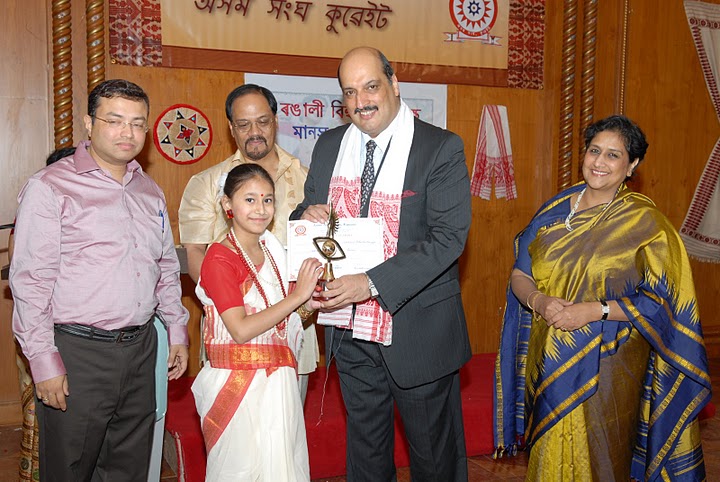
 The Ambassador of India, Shr Ajai Malhotra along with his wife Ira Malhotra graced the occasion. An exhibition of Assamese artifacts and the paintings from the drawing competition was show-cased for the first time. Our annual magazinr JETUKA was also released by his excellency on that day. The dance performances by our kids, songs by the ladies and bihu by both ladies and gents were appreciated by all. And finally the electrifying and wonderful performance by Manas Robin made it an evening to remember. I was part of the chorus and Bihu dance…..was little nervous but all went well.


The list of programme that followed were….


1 Felicitation of Guests


2 Lighting of the ceremonial lamp


3 Exhibition of Assamese Artifacts & Childrens Paintings


4 Welcome speech by the President, Asom Association, Kuwait


5 Address by his Excellency, Sri Ajai Malhotra, Ambassodor, Embassy of India, Kuwait


6 Release of Jetuka by Mrs & Mr Ambassador


7 Prize distribution for Essay & Drawing Competition by Mrs & Mr Ambassador


8 Chorus by members of the Association


9 Assamese modern dance


10 1st Performance by Manas Robin


11 Husori by members of the Association


12 Bharat Natyam recital


13 Fashion show by kids


14 Jhumur dance


15 Modern Indian dance


16 Presentation of Memento to Manas & Hemanta


17 Vote of thanks by the General Secretary, Asom Association, Kuwait


18 Main performance by Manas Robin


19 Dinner


Sunday, April 18, 2010

BIHU @ Fintas Park,Q8

The Assamese Community of Kuwait celebrated Rongali Bihu, the most important festival of the Assamese people of India at Fintas Park, Mahboula on 16th of April 2010. Lot of families gathered bringing with them home made, variety of traditional Bihu snacks and foodstuff’s. Games were organized for both children and couples. We all enjoyed them and the celebration ended with a nice homemade dinner . Hats off to all the ladies who prepared all the tasty Bihu snacks and dinner items.


Bihu snacks are very tasty and easy to prepare. Some of the popular Assamese Bihu snacks are Til Pitha, Narekol Ladoo, Ghila Pitha, Til Ladoo, Besan Ladoo and many more. Sharing with you some of Bihu receipes.....


Til Pitha Recipe

Til Pitha is a very popular Assamese recipe. Learn how to make/prepare Till Petha by following this easy recipe.
 
Ingredients:
• 2 cups Glutinous Rice

• 100 gm Jaggery

• 80 gm Black Sesame Seeds

• 4 cups Water
How to make Til Pitha:

• Soak the rice overnight in water.

• Drain excess water and grind it carefully.

• Roast sesame seeds and pound them to remove their outer shell.

• Cut Jaggery into small chips and combine the sesame seeds with it.

• Heat the griddle and spread the rice batter over it to the size of Puri with the help of a ladle.

• While it is being roasted, put the stuffing of jaggery and sesame mixture in its middle.

• As and when the rice batter gets firm, fold its sides to cover the stuffing.

• Turn it over and heat lightly before taking it off from the fire. Ensure that jaggery doesn't melt and flow out.

• Til Pitha is ready to eat.

Narikel Laddoo Recipe


Narikel Laddoo is a sweet delight savored during Assamese Festival, Bihu.

Ingredients:

• 2 Coconuts

• 2 cup Sugar

• 1 tbsp Ghee
How to make Narikel Laddoo:

• Grate both the coconuts in a plate.

• Take a saucepan and put grated coconut and sugar in it. Stir them well, over medium heat.

• Once the water from coconut starts making lumps, remove the mixture from fire.

• Grease your hands with a little ghee and roll the coconut mixture into small laddoos (balls).

• Make sure that the mixture is not allowed to cool, as it would prevent you from making laddoos.

• Serve when the laddoos come down to room temperature.

Ghila Pitha Recipe


Ghila Pitha another very popular Assamese recipe prepared in the festive occassion of Bihu.
Ingredients:

• 1 kg Rice Flour (sieved)

• ½ kg Jaggery (grated)

• 200 g of Cooking Oil

• 1 cup of Warm Water

How to make Ghila Pitha:

• Add jaggery to a cup of warm water and mix well.

• Let it to stand for some time.

• Fold the rice flour into the jaggery water.

• Now knead well till the dough is smooth.

• Keep it covered aside for 10 minutes.

• Divide the dough into equal portions and make small balls.

• Flatten them into half-inch thick rounds.

• Finally, fry them on a medium flame till they are brown on both sides.

Til Ladoo

 Method

Step 1: Lightly roast the sesame seeds. Heat the jaggery in a pan till it melts and then add the roasted sesame seeds to it.

Step 2: Once the jaggery starts to firm up, remove from fire.

Step 3: Lightly grease your palm with some ghee and roll one tablespoon of the mixture into a ball.

Step 4: Be careful with the hot jaggery but the balls should be made while the mixture is still hot.

Step 5: Serve when the balls come to room temperature.

Ingredients

Sesame seeds 40 gm

Black or Brown Jaggery 50 gm

Ghee 1 tablespoon

Try making them.....You will surely love it.