Showing posts with label Rongali Bihu Q8. Show all posts

Tuesday, May 24, 2011

Shanta Uzir Nite,Kuwait,2011

This time for our Rongali Bihu celebration, we had the versatile Assamese singer Shanta Uzir and her music-director husband as our special guest.  She gave a great performance and made everyone present on Hotel Crown Plaza's ball room on 13 May, to dance to her songs.


An evening to remember and cherish.....


Jetuka 2011


Again I started neglecting my blog for few days…and whenever I do it, I feel very bad and sometimes helpless. This time it was the Bihu Celebration that took all my time and energy and I could not do anything. Infact I was fighting against time to publish our ( Assam Association Kuwait) annual magazine Jetuka as I was one of the editors. Alok da (Alok Das) was the other editor, we worked as a team. We get very less time; the new committee gets elected in March but cannot do anything till the previous resigns. By the time the new members take over, decide on the theme, request for article, edit them and then publish them, we have very little time.Apart from the magazine, I was part of the Bihu group dance, which we say Husori. So I had to run to press and for practise.

Anyway, all went well. We were able to publish the magazine on time….on Santa Uzir Nite. Shanta Uzir, a very versatile star of Assam, gave a sterling Performance at a Bihu Function held on 13-May-2011 at Hotel Crowne Plaza. It was an evening which we all are sure to remember. All went well, as planned. Everyone from kids to adults enjoyed.

Here are some pictures....


Thursday, April 14, 2011

Kapau Flower,Assam,india

"KAPAU FLOWER" is the state flower of Assam and Rongali Bihu is incomplete without this flower. Its a very beautiful purple coloure orchid. We have it at home and as a kid, I still  remember waiting for it to bloom so that we can use it during bihu. Young women perform Bihu, the traditional dance, wearing Muga attire and decorated with kapou on their head/hair and traditional ornaments.

This flower is the part and parcel of the Assamese community.

Rongali Bihu,Assam,India

Rongali Bihu (mid-April, also called Bohag Bihu), the most popular Bihu celebrates the onset of the Assamese New Year (around April 15) and the coming of Spring. This marks the first day of the Hindu solar calendar and is also observed in Bengal, Kerala, Manipur, Nepal, Orissa, Punjab and Tamil Nadu though called by different names. It's a time of merriment and feasting and continues for several days. The farmers prepare the fields for cultivation of paddy and there is a feeling of joy around. The ladies make pitha, larus (traditional food made of rice and coconut) and Jolpan which gives the real essence of the season. The first day of the bihu is called goru bihu or cow bihu, where the cows are washed and worshipped, which falls on the last day of the previous year, usually on April 14. This is followed by manuh (human) bihu on April 15, the New Year Day. 


I had already written about BIHU in my earlier post. You can have a look at it to understand it better
http://mytravelsmyexperiences.blogspot.com/2010/04/happy-rongali-bihu.html


Tomorrow, here in Kuwait we are celebrating Rongali Bihu at Fintas park where there will be games for kids and adults; will have our traditional breakfast and snacks and will end with lunch.


For the last few days, sandstorm have being creating havoc here in Kuwait. Just praying and hoping that it is a clear nice weather tomorrow .

Saturday, May 22, 2010

Bihu Dance , Assam, India


The Bihu is the most widespread folk dance of Assam and is enjoyed by all, young and old, rich and poor. It is also a part of the life known as Assamese life. The folk dance cuts through all the religious, caste and class barriers of the different kinds of people living in Assam. The dance is part of the Bihu festival, that comes in mid-April, when harvesting is done, and continues for about a month. The participants are young men and girls, who gather in the open, in daytime. These performers dance together but are not paired together and form in lines when they dance. The music played at this dance are drums and pipes and the performers sing of love during the act. The pattern which the performers follow during the dance is the circle or the parallel rows. The dancers sway their hips, take brisk steps and fling and flip their hands when the dance progresses. Dancers wear traditionally colorful Assamese clothing.

The Bihu dance is performed in conjunction with traditional Bihu folk music, played with: the "dhol", similar to a drum; the mohor singor pepa, a pipe instrument made from a buffalo horn; the tala, a cymbal; the gogona, a reed and bamboo instrument; and the toka, a bamboo clapper. The songs (bihu geet) that accompany the dance have been handed down for many generations. The subject of the lyrics ranges from welcoming the Assamese new year to describing the daily life of a farmer, from historical references of invasions to Assam to contemporary socio-political commentary in a satirical way.

Sharing pictures of Bihu dance that we performed on 14 May on occasion

of celebrating Bihu at Asia Asia's Royal Ballroom at Kuwait City.....


Monday, May 17, 2010

Rongali Bihu Cultural Night,Q8

We had an entertaining and wonderful evening last Friday(14th of May). We celebrated our Rongali Bihu Cultural Night which was held at Asia Asia’s Royal Ball Room.
 The Ambassador of India, Shr Ajai Malhotra along with his wife Ira Malhotra graced the occasion. An exhibition of Assamese artifacts and the paintings from the drawing competition was show-cased for the first time. Our annual magazinr JETUKA was also released by his excellency on that day. The dance performances by our kids, songs by the ladies and bihu by both ladies and gents were appreciated by all. And finally the electrifying and wonderful performance by Manas Robin made it an evening to remember. I was part of the chorus and Bihu dance…..was little nervous but all went well.


The list of programme that followed were….


1 Felicitation of Guests


2 Lighting of the ceremonial lamp


3 Exhibition of Assamese Artifacts & Childrens Paintings


4 Welcome speech by the President, Asom Association, Kuwait


5 Address by his Excellency, Sri Ajai Malhotra, Ambassodor, Embassy of India, Kuwait


6 Release of Jetuka by Mrs & Mr Ambassador


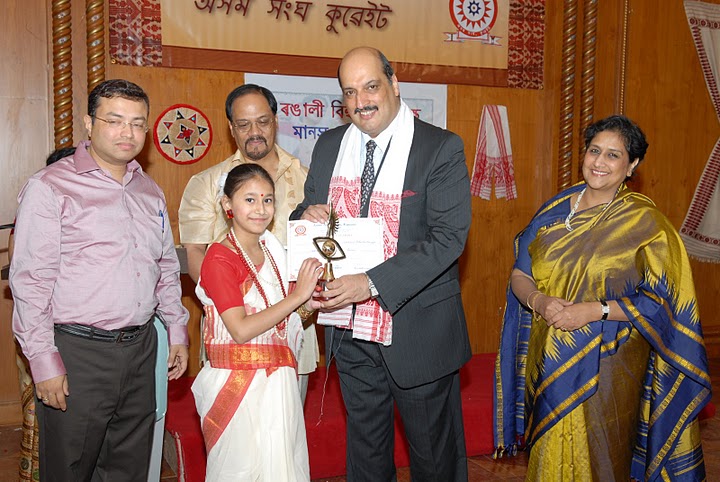
7 Prize distribution for Essay & Drawing Competition by Mrs & Mr Ambassador


8 Chorus by members of the Association


9 Assamese modern dance


10 1st Performance by Manas Robin


11 Husori by members of the Association


12 Bharat Natyam recital


13 Fashion show by kids


14 Jhumur dance


15 Modern Indian dance


16 Presentation of Memento to Manas & Hemanta


17 Vote of thanks by the General Secretary, Asom Association, Kuwait


18 Main performance by Manas Robin


19 Dinner